








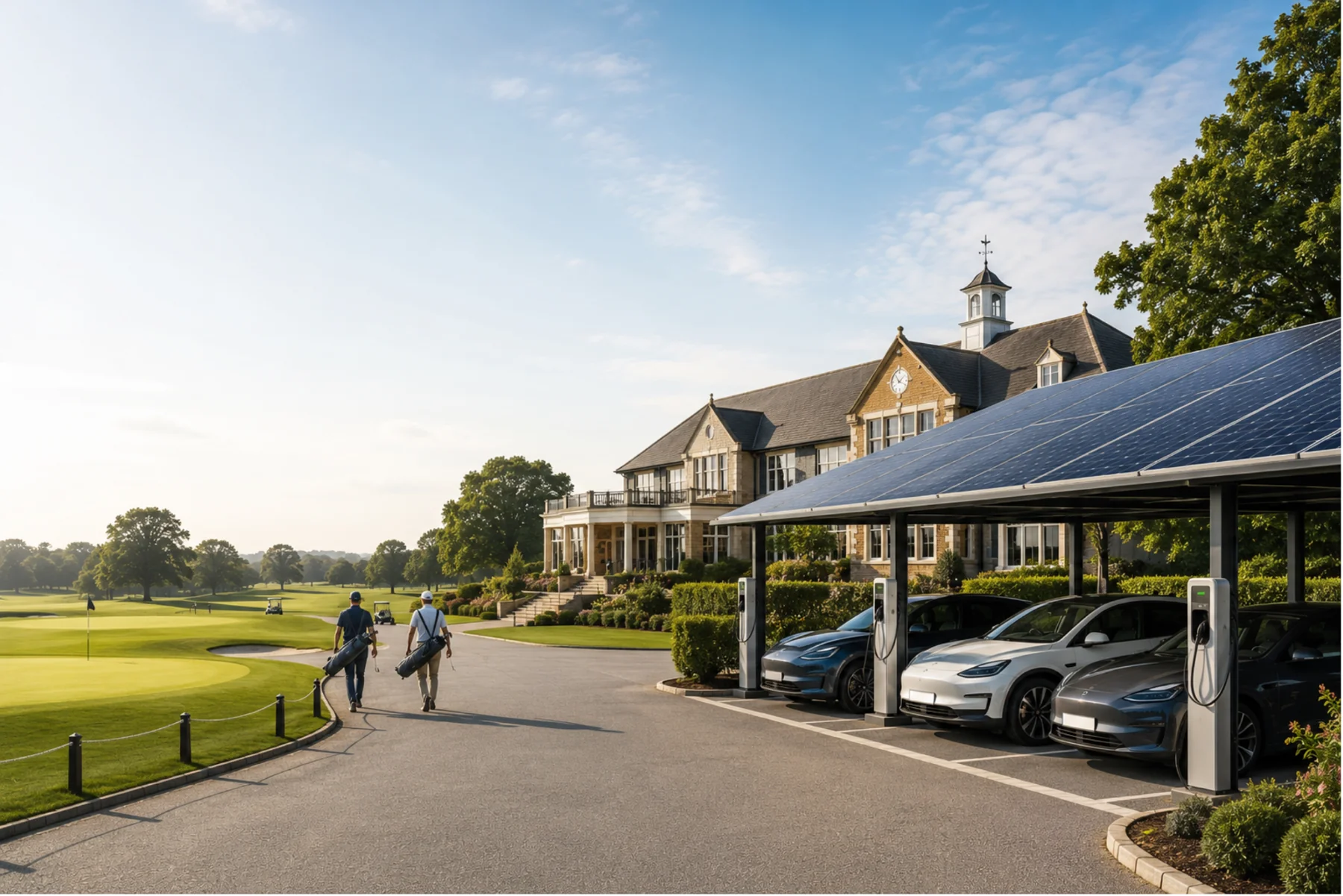
AI-generated illustrative image: a golf clubhouse and course with a solar carport and electric vehicle charging. It does not depict a real Eco Providers customer or property.
A golf club is not one energy user. It is a collection of different operations sharing a site: hospitality, changing facilities, course maintenance, irrigation and, increasingly, electric vehicles and equipment.
That distinction should shape the investment strategy. A clubhouse roof may be suitable for solar, but a strong proposal starts with when the club uses energy, which services it must protect and how decisions are approved. Equipment comes after those questions.
For club managers, including readers across the CMAE community, the aim is a plan the board can understand, staff can operate and members can trust. The framework below is relevant across the UK, Ireland, the Channel Islands and Europe; local technical, commercial and regulatory requirements must be checked separately.
Connected to the club-management community
Eco Providers is a member of the Club Managers Association of Europe (CMAE). This article is written for club decision-makers balancing operational performance, member experience and long-term investment. Membership does not imply CMAE endorsement of this guidance.
Club energy strategy at a glance
- Separate clubhouse, hospitality and course-related demand.
- Account for seasons, events, opening hours and planned changes.
- Compare efficiency improvements with generation and storage.
- Protect service quality, course care and operational resilience.
- Make each investment and community commitment accountable.
Map the operating model before choosing equipment
The same club can have a quiet winter clubhouse, a busy summer terrace, early-morning maintenance and evening functions. A single annual bill conceals those differences. It can also hide whether a cost sits with the club, an outsourced caterer or another operator.
Bring the general manager, finance lead, course manager and hospitality team into the first discussion. Ask each to identify essential services, flexible activities and foreseeable changes. The point is not to move every load into sunshine hours; it is to understand what can realistically change without harming the experience or the course.
On a smaller screen, swipe the table horizontally.
| Operation | What to investigate | What must be protected |
|---|---|---|
| Clubhouse and changing facilities | Opening hours, heating zones, ventilation and hot-water demand. | Comfort, hygiene and safe building operation. |
| Kitchen, bar and events | Refrigeration, cooking schedules, extraction and event peaks. | Food safety, service capacity and contractual responsibilities. |
| Course and maintenance facilities | Pumping, workshop loads, machinery and charging schedules. | Turf health, agronomic requirements and safe maintenance routines. |
| Member and visitor charging | Likely utilisation, dwell time, tariffs and electrical capacity. | Usable parking, accessible provision and a clear service model. |
The Carbon Trust’s hospitality guidance provides a useful checklist across heating, hot water, lighting, catering and staff practices. Apply it to the club’s actual facilities rather than assuming a restaurant, hotel and golf clubhouse operate identically.
Build a baseline that explains the bill
Start with a representative year of electricity and fuel data, preferably including interval electricity readings. Add opening hours, events, periods of closure and notable weather-related disruption. If an unusually quiet or busy year is used, make that limitation visible.
Where the main meter cannot explain the largest loads, consider a proportionate metering survey or temporary monitoring. Do not buy a complex dashboard before deciding what questions it must answer and who will use it.
Track absolute consumption alongside useful operational indicators, such as clubhouse opening hours or occupied function days. A lower bill caused by fewer visitors is not necessarily an efficiency success. Likewise, a busier club may use more energy while operating each service more efficiently.
Keep a separate schedule of future changes: extended catering hours, new practice facilities, electric maintenance equipment or accommodation. Model confirmed projects and possible projects separately.
Choose a sequence, not a shopping list
First investigate avoidable waste and control settings. Then assess generation and other investments against the demand that is expected to remain. Changes to heating, lighting or operating schedules can alter the assumptions used to size solar and storage.
Solar: assess the match with daytime demand
When assessing commercial solar PV for your club, ask for a site-specific generation model and a realistic estimate of on-site use. Annual totals alone do not establish that match. SEAI’s solar PV guide for businesses discusses demand matching and self-consumption; its Irish policy context should not be transferred to other jurisdictions.
Roof condition, visual impact, structural suitability and any heritage constraints belong in the early assessment. All-black panels may suit the club’s visual brief, but appearance should be considered alongside the full technical specification, roof design and whole-life costs.
Storage: specify the job before the size
Ask what the battery is intended to do and when it will do it. Compare the incremental benefit with solar alone, accounting for losses, operating limits and future replacement. Do not assume ordinary battery storage keeps the clubhouse running during a power cut; any backup requirement needs a separately defined design.
Heating and hot water: protect service quality
Plan around building heat demand, hot-water requirements and the existing distribution system. A professional assessment should establish what needs to change before equipment is selected. Do not base a winter heating plan on an annual solar-generation total.
Charging: treat it as an operating service
Clarify whether charging is primarily for maintenance equipment, staff, members or visitors. Each use has different availability and management needs. Include maintenance, payment arrangements where relevant, load management and customer support in the plan, not only the hardware.
Give the board a decision it can interrogate
A useful board paper explains the current problem, the preferred route, the alternatives and the reasons for rejecting them. It should also identify the decision needed now. Approval to investigate is not the same as approval to buy.
- Purpose: cost control, replacement of ageing assets, lower emissions or a defined service improvement.
- Evidence: consumption baseline, survey findings and gaps still to close.
- Options: a comparable base case, preferred option and downside scenario.
- Whole-life commitments: installation, financing where relevant, maintenance, replacement and end-of-term obligations.
- Delivery: procurement, permissions, member communications and event-calendar constraints.
- Accountability: a named project owner and a reporting schedule after handover.
Where a member vote, landlord consent or another approval is needed, identify it before a supplier programme is treated as fixed. Preserve the decision record so a future committee can understand the assumptions rather than inherit an unexplained forecast.
See a commercial project in practice
Our Kinrise Real Estate case study describes a 28 kWp rooftop solar installation at a mixed-use Leeds building. It is a useful example of a site-specific commercial project, not a golf-club savings forecast. Review the documented scope and ask what evidence would be needed for your own premises.
Explore our commercial solar assessment and installation approach for the next stage of planning.
Use one decision framework, not one set of rules
Club managers can share good practice across borders without assuming the same connection process, tariff, incentive or permission applies everywhere. This article does not present a universal grant or export-payment offer.
| Club location | What the project team should confirm locally |
|---|---|
| England, Scotland and Wales | The serving distribution-network operator’s requirements, relevant national and local planning position, supply contract and export arrangements. |
| Northern Ireland | The applicable local network, planning, supply and export requirements; do not assume Great Britain procedures apply. |
| Republic of Ireland | Irish connection and planning requirements, supplier terms and any currently available support with its eligibility conditions. |
| Jersey and Guernsey | The relevant island’s utility and consent requirements, commercial terms and installer arrangements. |
| Other European countries | Country-specific rules, qualified local delivery, tax treatment, permissions and commercial contracts. |
Confirm who owns each local check. Association membership is a route to professional discussion, not evidence of regulatory approval, funding entitlement or an installer’s delivery coverage.
Connect energy investment to genuine social value
An energy project can support a wider club strategy, but panels alone do not prove community impact. Nor should an installation be presented as making the whole club sustainable. GEO Foundation’s Sustainable Golf resources place club improvement within a broader approach; energy should sit alongside, not replace, attention to nature, resources and community.
Choose one or two commitments the club and delivery partners can actually fulfil. For example, a supervised careers session could introduce local learners to energy and estates roles. A board might agree to reinvest a defined, verified financial benefit into accessible introductory golf sessions. Neither outcome happens automatically.
For each commitment, record the intended beneficiaries, delivery partner, budget, owner and evidence. Measure completed activity and participation first; make stronger impact claims only when there is evidence to support them. Obtain permission before using participants’ photographs or stories.
Communicate progress to members in plain language: what was planned, what was delivered, what the energy data shows and what remains uncertain. Credibility is more valuable than a broad environmental slogan.
A COMMERCIAL PERSPECTIVE FROM GRAHAM BAILIE
“For a golf club, energy investment should support the operation, not dictate it. Start with how the clubhouse and course use energy, then build a phased plan that protects the member experience and gives the board a clear view of costs, benefits and responsibilities.”
Graham Bailie - Head of Commercial
A practical first 90 days
This is an illustrative management timetable, not a promise of installation within 90 days. Surveys, consents and network processes may take longer.
- Days 1 to 30 - establish the evidence. Appoint an owner, collect consumption and operating data, map responsibilities and record planned capital projects.
- Days 31 to 60 - test the options. Review controls and efficiency opportunities, commission proportionate surveys and compare suitable energy scenarios.
- Days 61 to 90 - prepare the decision. Present a preferred route with risks, costs, dependencies, local checks and a measurable social-value commitment. Agree the next approval gate.
Frequently asked questions
Should a golf club install solar before improving efficiency?
Assess both together. Agreed efficiency changes may affect future demand and therefore the appropriate solar design. There is no single sequence for every club.
Will installation disrupt members or events?
Agree access, deliveries, working areas and any electrical shutdowns before work begins. Plan around competitions, functions and essential course operations. The programme and any restrictions should be communicated to staff and members in advance.
Can one club copy another club’s payback estimate?
No. Use the other project as a discussion point, not a forecast. Demand, tariffs, roof conditions, financing and delivery costs may differ materially.
How should seasonal demand affect the proposal?
Compare consumption and expected generation across the year, including quieter periods, winter heating and event peaks. A summer operating pattern should not be used as a proxy for the whole year. Ask for both the annual picture and the months that drive the investment case.
What should we gather before speaking to a supplier?
Start with the site address, recent electricity bills, available interval data, opening hours, roof information and planned upgrades. Identify who owns the building and who can approve the project. Missing information can then become a defined assessment task.
Discuss your club’s energy strategy
Bring your priorities and site information to our commercial team. We can confirm service coverage and help identify the appropriate next step.
- Club location and building ownership
- Recent electricity bills and available interval data
- Opening hours, event patterns and planned upgrades
Sources and further reading
- Carbon Trust: energy efficiency guidance for hospitality (operational guidance, not a current funding offer).
- SEAI: Solar PV for Business - Best Practice Guide (technical guidance; Irish policy context).
- GEO Foundation: Sustainable Golf resources for courses.
Sources checked 6 November 2026. General planning information only. Site suitability, safety, permissions, commercial terms and any financial or tax implications require appropriate local professional advice. No savings, funding, accreditation or endorsement is guaranteed.